
Client conviction fades
The client may understand the plan in the meeting. Later, they may struggle to explain it to family, business partners, accountants or lawyers.
Home / AI for insurance advisors
Context-First AI for insurance advisors and teams
At a glance
Grove-White & Co. helps insurance advisors use Context-First AI for case drafts and handoffs. Workshops and advisory support use approved sources and firm standards. People review the work. Advisors keep control of judgement and remain accountable for their own work.
A complex case may pass to an accountant, underwriter or colleague after the client meeting. Each person needs the facts and the client's goals. They also need to know why you gave that advice.
We work with insurance practices, advanced markets teams and managing general agencies. Start with a keynote or workshop. Add workflow advice, setup support or a retainer if your team needs more help.
On this page: Case handoffs · Practical uses · Workshops and advisory · Implementation support · Case workflow · Data and review · Insurance FAQs
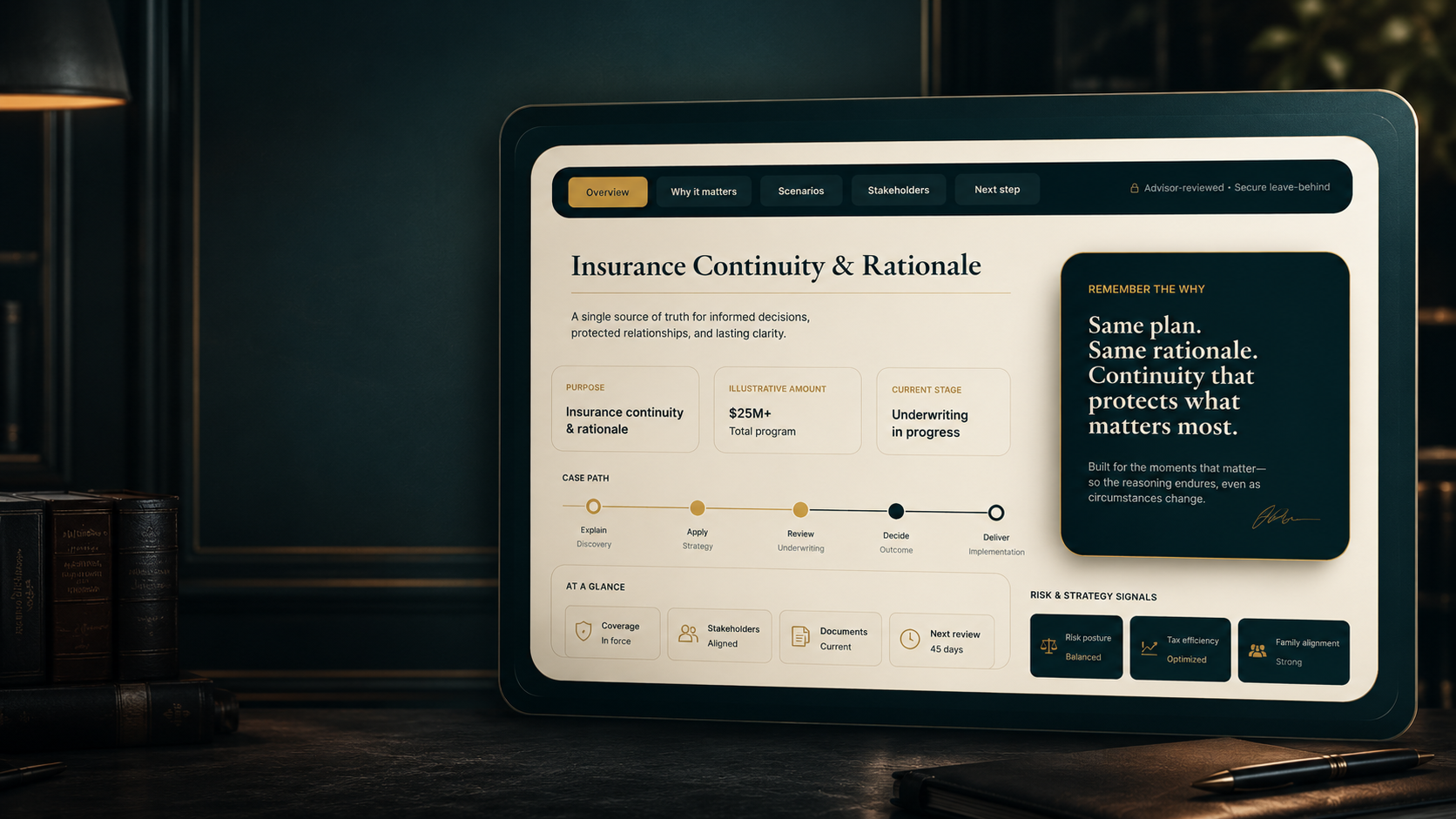
Complex insurance cases can take months to work through. The client may hesitate. An accountant may raise a tax question. An underwriter may need more facts.
The advisor may know the family, the business risks and the reasons for the plan. They may also know why the client needs cash available and what worries them most. The next person to review the case needs that context too.
When those details stay in the advisor's head, handoffs become harder. Start with a simple question: what does the next person need to know?
The client may understand the plan in the meeting. Later, they may struggle to explain it to family, business partners, accountants or lawyers.
Each person reviews the case from a different angle. Missing context can lead to more questions, delays and work that has to be done again.
If only the advisor knows the reasoning, each handoff needs their help. They have to explain the same thinking again and again.
A useful AI draft starts with the case facts, the client's priorities and the firm's standards. It also needs clear rules about what the advisor must check.
With those in place, AI can help prepare the work below.
Keep the reasons for the plan clear at each stage. That includes the client meeting, team handoff, accountant review, underwriting and the return to the client.
Turn notes and the advisor's thinking into a first draft. The advisor then checks, improves and signs off on it.
Keep the client's own words, goals and concerns in the record. Use them to show how the plan relates to what matters to the client.
Explain the reasons for the plan in plain language. Flag points the accountant needs to check so the handoff is easier to review.
Gather the case facts and open questions before submission. Make assumptions and gaps clear so they can be checked.
AI can help prepare the work. The advisor remains accountable for the final advice. That includes its accuracy and tone, and the client's trust.
The right support depends on where your team is starting. A keynote explains the options. A workshop helps you work through a chosen task. Setup support helps define the sources, permissions and checks needed to use that task again.
A keynote gives the audience a shared starting point.
It suits advisors, leaders and event audiences who want to understand AI's role in complex insurance work.
Typical outcome:
A workshop helps your team choose where to start.
Work through useful tasks, agree on approved limits and decide where AI can help.
Typical outcome:
A retainer helps put the workshop plan into practice.
It suits teams ready to build repeatable ways to use AI in work where trust and rules matter.
Typical outcome:
Before a team uses AI on real case work, it needs more than a useful draft. It needs clear rules for the whole task.
Use these questions to check whether the workflow is ready:
Grove-White & Co. helps insurance teams answer these questions, record the decisions and put them into practice.
The aim is a shared process the firm can check and maintain as AI use grows.
Once the task and its limits are clear, we can agree on the support needed. Scope is set after a workshop or advisory conversation. The focus is repeatable work that needs clear context, sound judgement and human review.
Choose which insurance tasks to improve first. Weigh their risks, value, how often they recur and whether the team is ready.
Give AI the approved sources, case facts, reasons for the plan and firm rules it needs. This is context engineering: choosing what information a task needs, how to arrange it and when to update it.
Build reusable steps for a task. Examples include case summaries, reason-why drafts, accountant explanations, client follow-up notes and team handoffs.
Record who reviews the work and what they must check. Set clear points where the task must stop until a professional has reviewed it.
Keep a reusable record of the client's goals, facts and concerns. Include the reasons for the plan, open questions and the case history.
Draw useful context from approved meeting transcripts. This can include the client's words, concerns, common questions and follow-up tasks, as well as ideas to improve work or create content.
Help advisors, associates, support staff and leaders learn to use the workflow. They do not all need to become AI experts.
Help the firm review and improve AI use over time. This can include workflow changes, planned context updates, leadership decisions and oversight.
A case summary is one way to put that support to use. The steps below show how approved source material becomes a draft the advisor can check.
Gather the relevant notes, transcript excerpts and client comments. Include the facts, goals, risks, assumptions and open questions.
Set out what is known, what is assumed and what still needs checking. Keep the advisor's reasons for the plan clear.
Keep a record that the team can return to. Include the client's goals, the reasons for the plan, other people's concerns and key details.
Use AI to help draft a letter, summary, explanation, briefing note or handoff. Treat the result as a draft that needs review.
Read the draft from the next person's point of view. Check what the client, accountant, underwriter, team and compliance reviewers need.
The advisor checks the draft and decides what to use. They remain responsible for final judgement, client advice, accuracy, tone and professional accountability.


This approach suits teams whose case work relies on client trust, sound judgement and clear handoffs. The lists below can help you decide whether it fits your practice.
Insurance work depends on trust. Client data, suitable products, sound conduct, privacy, records and review standards all matter.
Before using AI, check:
Use AI only when the context, task, review process and lines of responsibility are clear enough to support the work.
This page is educational and does not provide legal, compliance, insurance, tax, accounting, or investment advice. Firms and advisors should follow their own professional obligations, privacy requirements, regulatory guidance, and internal policies.
Those rules need to hold up in day-to-day work. A workshop helps the team agree on a plan. A retainer provides support as the team puts it to use.
Grove-White & Co. offers ongoing advice for insurance and advisory teams using Context-First AI. Support may include:
Support focuses on work where firm rules, trust, context and human review matter.
Private workshops typically start at $5,000. We set the scope after an initial conversation. Final pricing depends on the audience, format and preparation, how much is tailored to your team, travel and follow-up.
Retainer scope depends on your goals, the tasks involved and the help needed to put them in place. We also consider your team's capacity and the risks involved.
AI can help turn your recorded reasons, client goals and case facts into a first draft. Use approved sources. Tell it to flag gaps rather than fill them in. You must check the draft against the case record, confirm the advice and complete your firm's review before using it.
Start with your reasons for the plan and the business owner's goals. Add the questions for the accountant. AI can help organise a briefing and flag points that need more detail. Make assumptions and open tax or legal questions clear. Each professional remains responsible for advice within their own role: accountant, lawyer or insurance advisor.
AI can help organise approved case facts and draft a summary. It can also flag questions to resolve before the handoff. Check every statement against the source record. The insurer sets the underwriting rules and makes the decision. An AI draft must not invent missing medical facts or predict an approval.
Keep a case record with separate parts for facts, client goals, your reasoning, assumptions and open questions. Note the source and date of key facts. An approved AI workflow can use that record to draft briefings for clients, family members or other professionals. Check each version for accuracy and what you are allowed to share.
Only if your firm has approved the tool, the data and the intended use. First check the firm's rules for consent, access, how long data is kept and how the work is supervised. Paying for a tool or removing names does not, by itself, give you permission. For workshops, use made-up cases or material expressly approved for that session.
Compare the draft with the approved sources. Check names, dates, amounts, client instructions, assumptions and missing facts. Check the reasons given for the advice, as well as quotes and source references. Record open questions. Complete the required review before anyone shares the draft or uses it for a client decision.
No. A workshop can help your team choose useful tasks and set clear data and review limits. It does not certify compliance. It also does not replace your firm's legal, privacy, technology or supervision processes. Those rules still govern whether you can use a workflow with real client data.
Yes, with a clear workflow. Staff need approved sources, task instructions and checks for the draft. Keep the advisor's reasoning separate from staff notes and AI suggestions. Set out which decisions need the advisor and who checks the work. Make it clear when staff must stop and ask for guidance.
Choose a task you repeat, with a clear result and approved sources you can access. Name someone who can judge its quality. Case summaries, meeting follow-ups and team handoff notes are options to assess. Run a small trial and compare the effort to prepare and review the work. Wait if data permissions or decision roles are unclear.
The scope should fit the audience and the work they need to improve. Topics can include case context, reason-why drafts, accountant or underwriting handoffs, approved data and advisor review. The team applies these ideas to chosen tasks. Before using those workflows on real work, the firm must complete its own approvals and checks.
Yes. We first agree on the scope. It can include source and context structures, task instructions, case-memory templates, review checklists and team training. A retainer can help the team use and improve the workflow. Before setup starts, agree who does the technical work, who owns the workflow and who supports it. Use the firm's approved system.
Compare the whole task, from the first draft to checks, corrections and follow-up. Look for accurate records, clear handoffs and less repeated explanation. Check any time saved too. Log errors and times when someone needed to step in. Keep or expand the workflow only if the evidence meets the team's rules for quality, permission and effort.
Start with one task your team repeats. It could be a case summary, an explanation for an accountant, an underwriting handoff or a follow-up after a delay.
We can discuss the data, your approved tools and who checks the work. From there, we can assess whether a workshop or ongoing advice fits.