
Client conviction fades
The client may understand the recommendation in the meeting, then lose clarity when the decision has to be explained again to family members, partners, accountants, lawyers, or internal stakeholders.
Context-First AI for insurance advisors and teams
Insurance advisors do some of their most valuable work when a case is complex, personal, and difficult to explain quickly.
Grove White & Co. helps insurance advisors, advanced markets teams, managing general agencies, and insurance leaders use AI with better context, clearer workflows, stronger review, and human judgement in control.
The work can begin with a keynote or private workshop. For teams ready to go further, it can continue into enterprise workflow advisory, regulated workload implementation support, and ongoing Context-First AI retainers.
The goal is practical: protect case momentum, improve handoffs, support better preparation, and help teams adopt AI without weakening professional accountability.
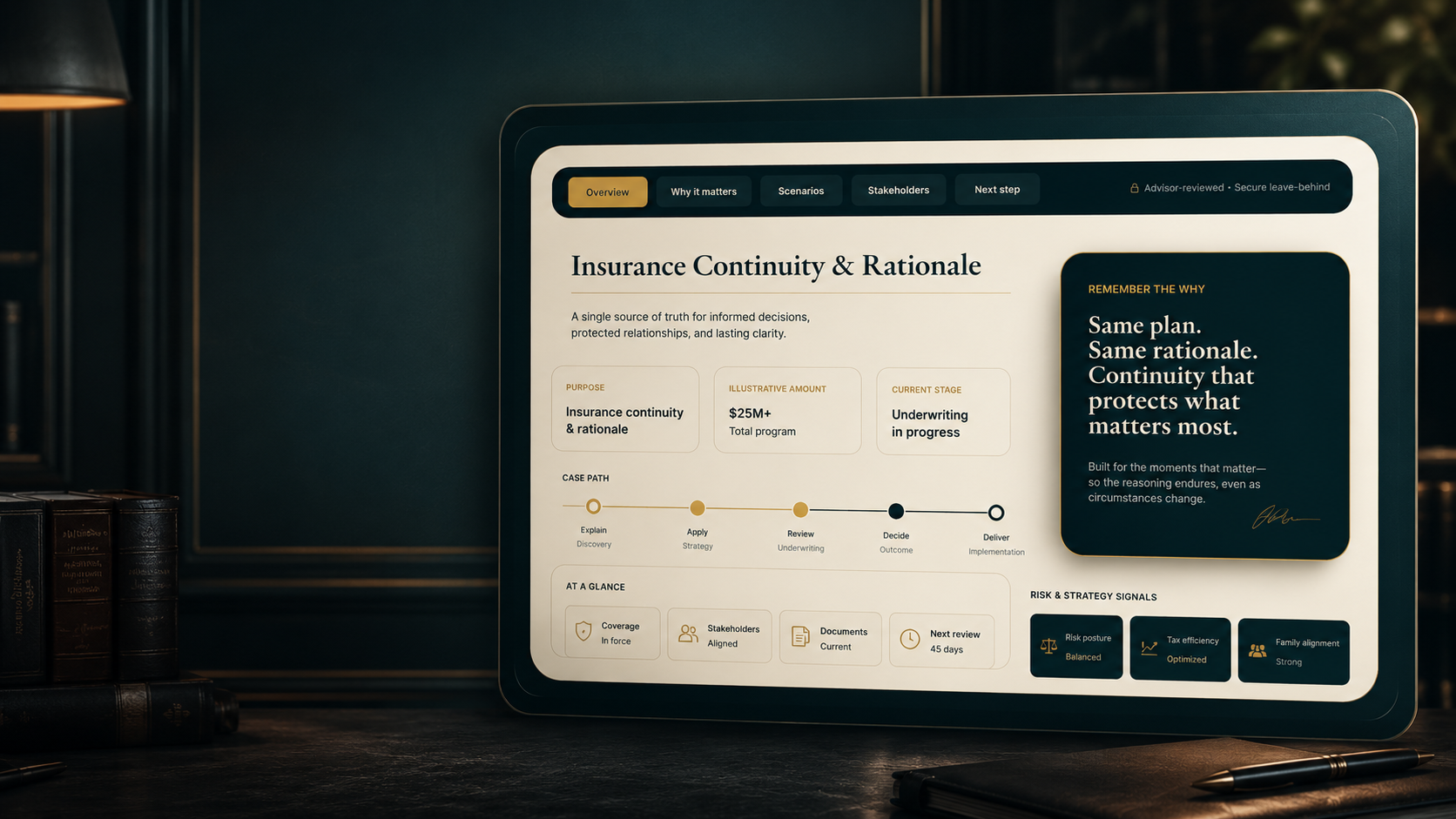
The client may understand the recommendation in the meeting, then lose clarity when the decision has to be explained again to family members, partners, accountants, lawyers, or internal stakeholders.
Accountants, lawyers, underwriters, assistants, associates, and internal teams each see the case through their own lens. Thin context creates avoidable objections, delays, and rework.
When too much of the case logic lives in the advisor’s head, every handoff depends on the advisor personally re-explaining the same judgement.
AI becomes more useful when it is grounded in the right case context, firm-approved workflows, and human review.
For insurance teams, the opportunity is not just faster drafting. The opportunity is to make important advisory context easier to preserve, reuse, review, and transfer across the complex case process.
Capture the client’s own language, goals, concerns, and decision logic so the recommendation stays connected to what matters most to them.
Keep the professional in control. AI can support preparation, but the advisor remains accountable for final advice, accuracy, tone, and client trust.
Many insurance teams start with the same problem: people are using AI in scattered ways, but the firm has not yet defined where AI belongs, what data can be used, what review is required, or which workflows are worth operationalizing.
That is why Grove White & Co. works in three stages.
A keynote creates shared language.
This is best when the goal is to help advisors, leaders, or event audiences understand how AI applies to complex insurance work, client trust, case preparation, and professional accountability.
Typical outcome:
A private workshop turns the conversation into practical workflow decisions.
This is best when a team needs to identify high-value use cases, align on approved boundaries, and decide where AI can support real advisory work.
Typical outcome:
An advisory retainer helps a team move from workshop clarity to controlled adoption.
This is best when the team is ready to operationalize repeatable AI-supported workflows across regulated or trust-heavy work.
Typical outcome:
For larger teams, the harder question is not whether AI can draft, summarize, or analyze information.
The harder question is whether the workflow is ready.
Before a regulated or trust-heavy workload should move into AI-supported use, the team needs to know:
Grove White & Co. helps insurance teams define, document, and operationalize these decisions.
This is useful for firms that want AI adoption to become a controlled business capability, not a scattered set of individual experiments.
Implementation support is scoped after a workshop or advisory conversation. The focus is on repeatable, high-trust workflows where better context, clearer review, and professional judgement matter.
Identify which insurance workflows are worth improving first based on risk, value, repeatability, and team readiness.
Define the source materials, client context, case logic, firm knowledge, and workflow instructions the AI needs before it can produce useful work.
Create reusable routines for specific tasks such as case summaries, reason-why drafts, accountant explanations, client follow-up notes, and internal handoffs.
Document where human review is required, who reviews, what must be checked, and what cannot move forward without professional judgement.
Build reusable structures that preserve client goals, key facts, concerns, rationale, open questions, and case history over time.
Turn approved meeting transcripts into usable business context: client language, objections, frequently asked questions, follow-up items, workflow improvements, and content opportunities.
Help advisors, associates, operations staff, and leaders understand how to use the workflow without turning every person into an AI expert.
Support adoption, refinement, workflow updates, scheduled conjtext refreshing, leadership decisions, and practical governance as the firm learns what works.
The goal is simple: Take the case out of the advisors head, but not out of their hands.
A Context-First workflow helps turn raw case information into reusable structure that supports better preparation, clearer handoffs, and stronger review.
Bring together the relevant meeting notes, transcript excerpts, client language, fact patterns, goals, risks, assumptions, and open questions.
Organize the case into what is known, what is assumed, what still needs to be confirmed, and why the advisor believes the recommendation makes sense.
Create a reusable working asset that preserves the client’s why, the recommendation logic, stakeholder concerns, and key details.
Use AI to support first-draft preparation for letters, summaries, explanations, briefing notes, and handoff materials.
Review the work through the lens of the client, accountant, underwriter, internal team, and compliance expectations.
The advisor remains responsible for final judgement, client advice, accuracy, tone, and professional accountability.
Our digital marketing agency offers services such as social media management, search engine optimization (SEO), pay-per-click advertising, content marketing, email marketing, and website design and development.
Our agency can help your business grow by increasing your online visibility, driving website traffic, generating leads, improving brand awareness, and ultimately increasing sales and revenue through targeted digital marketing strategies.
Yes, we understand that every business is unique, and we tailor our digital marketing solutions to meet the specific needs and goals of each client. We offer customized strategies and campaigns to ensure maximum effectiveness.
Absolutely. We provide detailed analytics and reports to track the performance of your digital marketing campaigns. This allows us to measure key metrics, identify areas for improvement, and adjust strategies to achieve the best results.
Our agency is distinguished by our team of experienced professionals, innovative marketing strategies, client-focused approach, and commitment to delivering tangible results. We prioritize transparency, communication, and collaboration with our clients.
Most clients begin seeing measurable improvements within the first 30 days of implementation. Our platform starts optimizing immediately, but the most significant results typically emerge after 2-3 months as our AI learns and refines your campaigns based on performance data.


This work is built for teams that operate in environments where client trust, context, judgement, and stakeholder handoffs matter.
Insurance advisors operate in a trust-heavy environment. Client information, product suitability, professional conduct, privacy, documentation, and review standards all matter.
That is why AI adoption should start with control questions:
The answer is rarely “use more AI.”
The better answer is: use AI only where the context, workflow, review process, and accountability are clear enough to support the work.
This page is educational and does not provide legal, compliance, insurance, tax, accounting, or investment advice. Firms and advisors should follow their own professional obligations, privacy requirements, regulatory guidance, and internal policies.
A workshop can create alignment. A retainer helps the work survive contact with real adoption.
Grove White & Co. provides advisory retainer support for insurance and advisory teams that want help turning Context-First AI into practical operating capability.
This may include:
This is not generic automation, chatbot setup, or one-off tool configuration.
It is advisory and implementation support for regulated, high-trust workflows where context, judgement, and review matter.
This work is built for insurance advisors, advanced markets teams, managing general agencies, carriers, life insurance leaders, and advisory firms that handle complex client work.
It is especially relevant when the case involves high-net-worth or ultra-high-net-worth clients, corporate planning, estate planning, tax-sensitive recommendations, underwriting preparation, or multiple professional stakeholders.
No.
The focus is broader than tool training.
We start with the advisory workflow: what context matters, where judgement lives, what the handoffs require, what outputs need review, and where AI can safely support preparation.
Tools come after the workflow is clear.
Yes.
For teams that are ready, Grove White & Co. can support enterprise workflow advisory, regulated workload implementation planning, context architecture, review checklists, workflow assets, and ongoing advisory retainers.
Implementation is scoped around repeatable, high-trust workflows where better context and stronger review can create meaningful value.
It means helping a team operationalize AI-supported work in areas where client information, professional judgement, review, documentation, and accountability matter.
Examples may include client meeting summaries, case memory assets, reason-why preparation, accountant-facing explanations, underwriting preparation notes, internal handoffs, and advisor enablement workflows.
The focus is workflow design, context architecture, review, and adoption support.
Grove White & Co. is not a generic software development shop.
Implementation support may include workflow assets, prompts, context structures, review checklists, internal enablement materials, and practical system design. Where technical configuration is required, it should be scoped clearly and aligned with the firm’s approved technology, data, compliance, and security requirements.
Only inside approved tools, approved data environments, and firm policy boundaries.
This work helps teams identify safer use cases, clarify where personal or confidential information should not be entered, and define review practices before AI becomes part of real advisory work.
Your firm’s compliance, legal, privacy, and technology policies remain the controlling authority.
No.
This is educational, advisory, and practical workflow support. It does not replace legal, compliance, privacy, tax, accounting, or insurance advice.
The goal is to help teams ask better control questions, structure safer workflows, and keep professional accountability clear.
Private workshops typically start at $5,000 and are scoped after an initial conversation.
Final pricing depends on the audience, format, preparation required, customization level, travel, and whether the work includes follow-up materials or implementation scoping.
Advisory retainers are scoped after the team’s goals, workflows, implementation needs, internal capacity, and risk environment are understood.
The right retainer depends on whether the team needs light advisory support, implementation guidance, workflow asset development, leadership enablement, or ongoing context and governance support.
A keynote is best when the goal is awareness, shared language, and advisor education.
A private workshop is best as a next step when a team wants to apply the ideas to real workflows.
An advisory retainer makes sense when there is already a clear desire to operationalize AI-supported work across repeatable, regulated, or trust-heavy workflows.
If your insurance team is trying to understand where AI belongs, which workflows are worth improving, and how to keep professional judgement in control, the starting point is a conversation.
We can discuss your audience, maturity level, approved tools, internal policies, priority workflows, and whether the right next step is a keynote, private workshop, or advisory implementation retainer.